

Iatrogenic nerve injury remains a significant and growing complication in modern surgery. With over 300 million surgical procedures performed globally each year, up to 8% of patients experience iatrogenic nerve injury. Rapid, wash-free visualization of peripheral nerves is highly desirable for fluorescence image-guided surgery (FIGS), yet existing probes lack spray compatibility and sufficient fluorogenicity. In the intraoperative setting, common challenges such as bleeding, fluid contamination, and tissue obstruction continue to hinder the real-time, high-resolution visualization of fine nerve structures. To address this challenge, the team led by Lu Wang at School of Pharmaceutical Sciences, Fudan University, developed N4, a near-infrared fluorogenic spray probe that enables ~10 s, wash-free visualization of peripheral nerves. N4 is engineered to remain non-fluorescent in its spirocyclic form under physiological conditions but undergoes MBP-triggered spiro-opening to a bright zwitterionic state, thereby markedly improving contrast and anti-interference capability in the surgical field. The related study, entitled “A Near-Infrared Fluorogenic Spray Probe for Rapid and Wash-free Intraoperative Nerve Imaging,” was published in the Journal of Medicinal Chemistry.
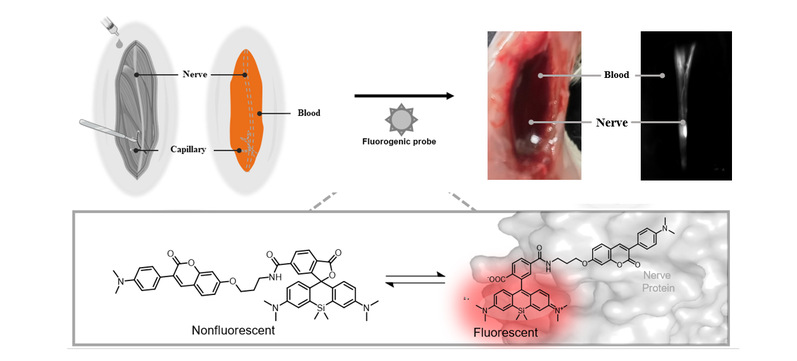
Figure 1. Nerve imaging performance and working principle of the rapid, wash-free near-infrared fluorogenic probe N4.
The newly developed N4 probe features a fluorogenic mechanism based on a spirocyclic-to-zwitterionic transition. Upon binding to myelin basic protein (MBP) in myelin-rich nerve tissue, N4 produces a robust fluorescence turn-on response, yielding a 6.3-fold turn-on. Following topical spray application, N4 produces clear sciatic and vagus nerve imaging within ~10 s and can be further extended to lumbar spinal nerves, with nerve-to-muscle contrast reaching up to 6.4. N4 also enables visualization of fine nerve branches as small as 0.12 mm. Even under blood-contaminated fields or blood-covered surgical fields, N4 maintains high-contrast nerve visualization, highlighting its practical utility for wash-free, spray-based fluorescence-guided nerve imaging under realistic surgical conditions. This work provides a robust platform for real-time FIGS nerve mapping and advances the development of next-generation fluorogenic surgical probes.
The first authors of the paper are Lijun Wang, Yushu Xi, and Pingting Gao. The corresponding authors are Prof. Lu Wang, Prof. Pinghong Zhou, and Prof. Xingdang Liu.