

Beyond its marked invasiveness and extensive heterogeneity, the malignant progression of glioblastoma (GBM) is heavily constrained by a metabolism-driven resistance mechanism characterized by aberrant terminal sialylation. Terminal sialylation not only stabilizes the conformations of multiple membrane receptors but also supports signaling redundancy by establishing high-throughput intercellular communication networks. Together, these features form a “metabolic-encoding” barrier that conventional therapeutic strategies struggle to overcome. However, substantial differences in the spatial organization, energetic requirements, and substrate specificity across sialylation-related metabolic nodes present major challenges for the rational design and effective delivery of targeted interventions.
To address this issue, the research team led by Prof. Chen Jiang and Assoc. Prof. Tao Sun proposed a precise blockade strategy targeting the metabolic-encoding layer. By concurrently inhibiting precursor generation and sialic acid activation, the approach enables systematic disruption of terminal sialylation on GBM cell surfaces. The team further engineered a “pathogen-derived nano-interferer” capable of crossing the blood–brain barrier (BBB) and designed to achieve microenvironment-responsive, on-demand release of regulatory molecules. Leveraging the metabolic dependence of GBM on sialylation-related glycan structures, this nanoplatform disrupts the tumor’s sialylation-based “language-encoding” mechanism, impairs signal integration capacity, and remodels intercellular communication networks. As a result, it effectively reverses metabolism-driven therapeutic resistance and enhances treatment responsiveness.
The study, entitled “Shutting Down the ‘Language Encoder’: A Pathogen-Derived Nano-Interferer Disrupts Sialylation Metabolism and Reprograms Intercellular Communication in Glioblastoma,” has been published in the internationally renowned journal Advanced Materials.
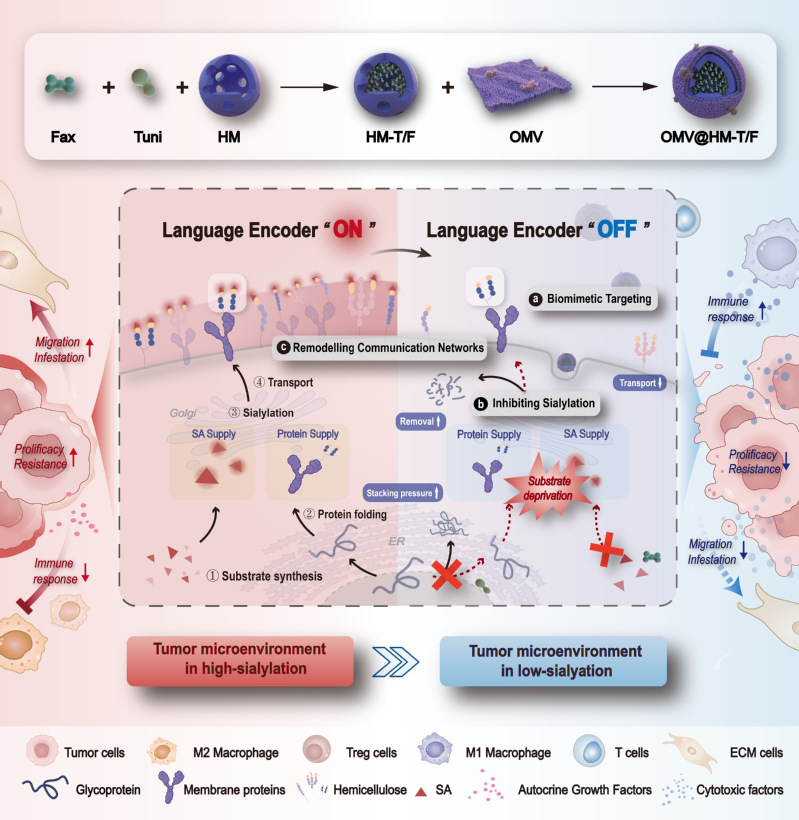
Jingyi Zhou, a Ph.D. candidate from the group, is the first author of the article. Prof. Chen Jiang serves as the corresponding author, and Assoc. Prof. Tao Sun is the co-corresponding author. This work was supported by the National Natural Science Foundation of China, the Shanghai Major Science and Technology Project, the Open Project Program of Pingyuan Laboratory, and Zhangjiang Laboratory.
Article link: https://advanced.onlinelibrary.wiley.com/doi/full/10.1002/adma.202516608