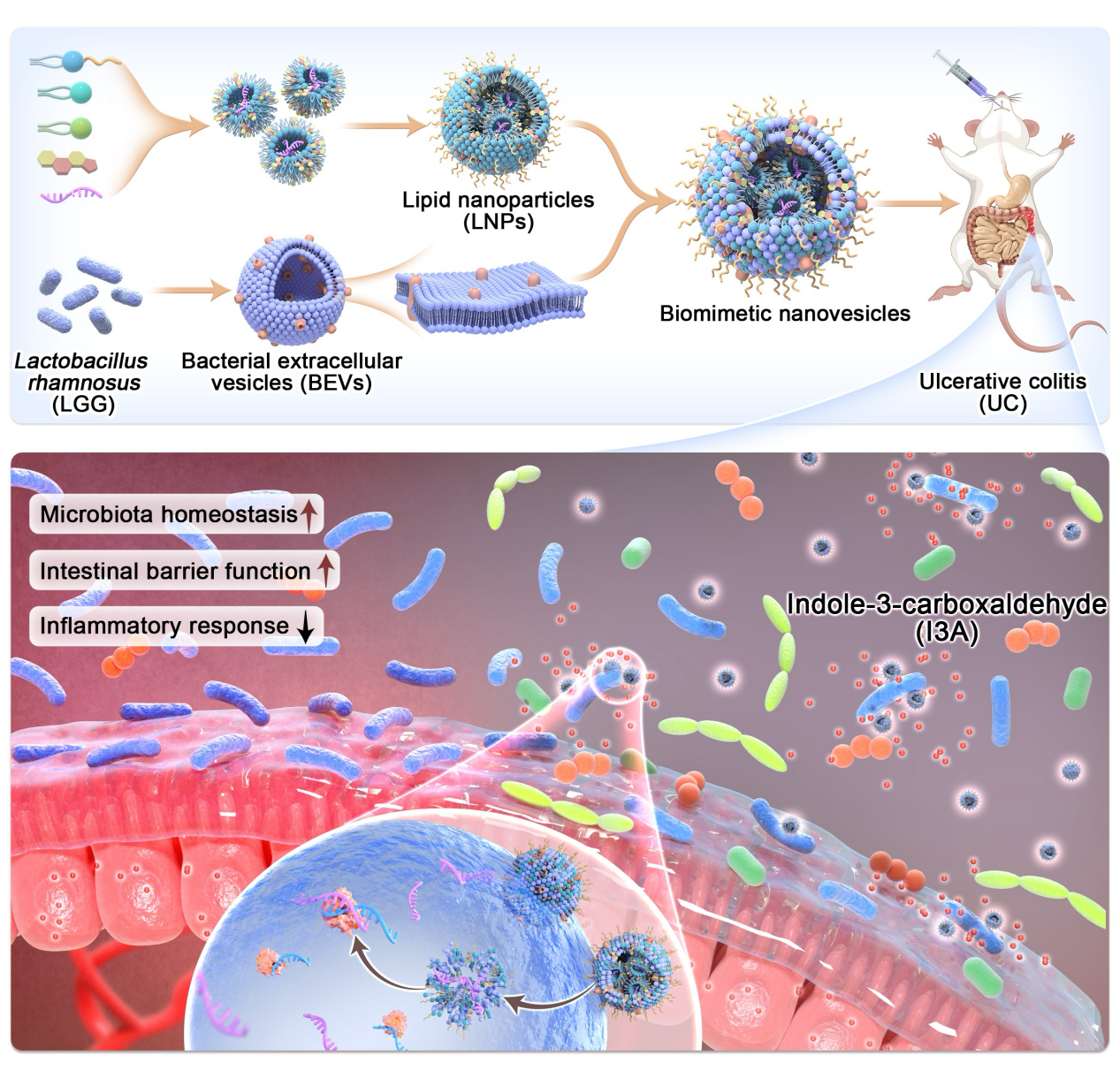

Inflammatory bowel disease (IBD) represents a group of globally prevalent intestinal disorders. Current treatments, including 5-aminosalicylic acid (5-ASA), corticosteroids, and anti-TNF-α antibodies often fail to achieve complete remission and are associated with adverse effects. Dysbiosis of the gut microbiota has been identified as a key factor in IBD pathogenesis, making microbial modulation a promising therapeutic strategy.
Recently, Professor Jianping Qi’s team developed a biomimetic nanoparticle system for targeted delivery of miRNA to regulate gut microbiota and ameliorate colitis. The researchers engineered bacterial extracellular vesicle-coated lipid nanoparticles (BEV-LNPs), which exhibited selective targeting toward the commensalLactobacillus rhamnosus overEscherichia coli. The BEV-LNPs demonstrated enhanced stability under physiological and gastrointestinal conditions compared with conventional LNPs. When combined with 5-ASA, the miRNA-loaded BEV-LNPs promoted the proliferation ofLactobacillus rhamnosus and increased production of the beneficial indole-3-carboxaldehyde. In both acute and chronic murine colitis models, this combinatory approach significantly alleviated intestinal inflammation, restored damaged epithelial barrier, and rebalanced gut microbiota.
This work presents an innovative oral delivery strategy that utilizes host-microbe crosstalk to achieve targeted gene regulation in gut bacteria, thereby overcoming limitations of conventional IBD therapies such as systemic toxicity and insufficient drug accumulation. The study highlights the potential of microbiota-centered nanomedicine for safe and effective management of IBD.
Ph.D. candidate Wenjuan Liu from the School of Pharmaceutical Sciences, Fudan University is the first author of this paper, and Professor Jianping Qi from the same institution is the corresponding author. This research was supported by the National Natural Science Foundation of China and the Shanghai Science and Technology Committee.
Link to the original article: https://www.science.org/doi/10.1126/sciadv.adw5984